Field guide 01 / Condition and provenance
Establish the watch's condition first
A sound restoration decision begins before a screw is turned. Establish what is present, what is uncertain and what the owner needs to preserve.
Begin with the owner's account
A mechanical watch arrives with two histories: the one its materials can reveal and the one its owner can tell. Neither is complete on its own. An inherited watch may have spent decades in a drawer, received an undocumented replacement dial, or stopped after an impact that nobody connected to its later behaviour. Record these accounts without treating recollection as proof.
Ask when the watch last ran, how it was stored, whether water or condensation was noticed, and whether anyone recently forced the crown. Previous invoices, dated photographs and inscriptions can establish useful anchors. Keep a distinction between “the family remembers” and “the service invoice records.” That distinction protects a good story from becoming an unsupported technical claim.
The owner's intended use matters just as much. Occasional careful wear may justify a different scope from daily use. A collection object retained primarily for its historical evidence may not need to run at all. Agree on these priorities before discussing cosmetic improvements.
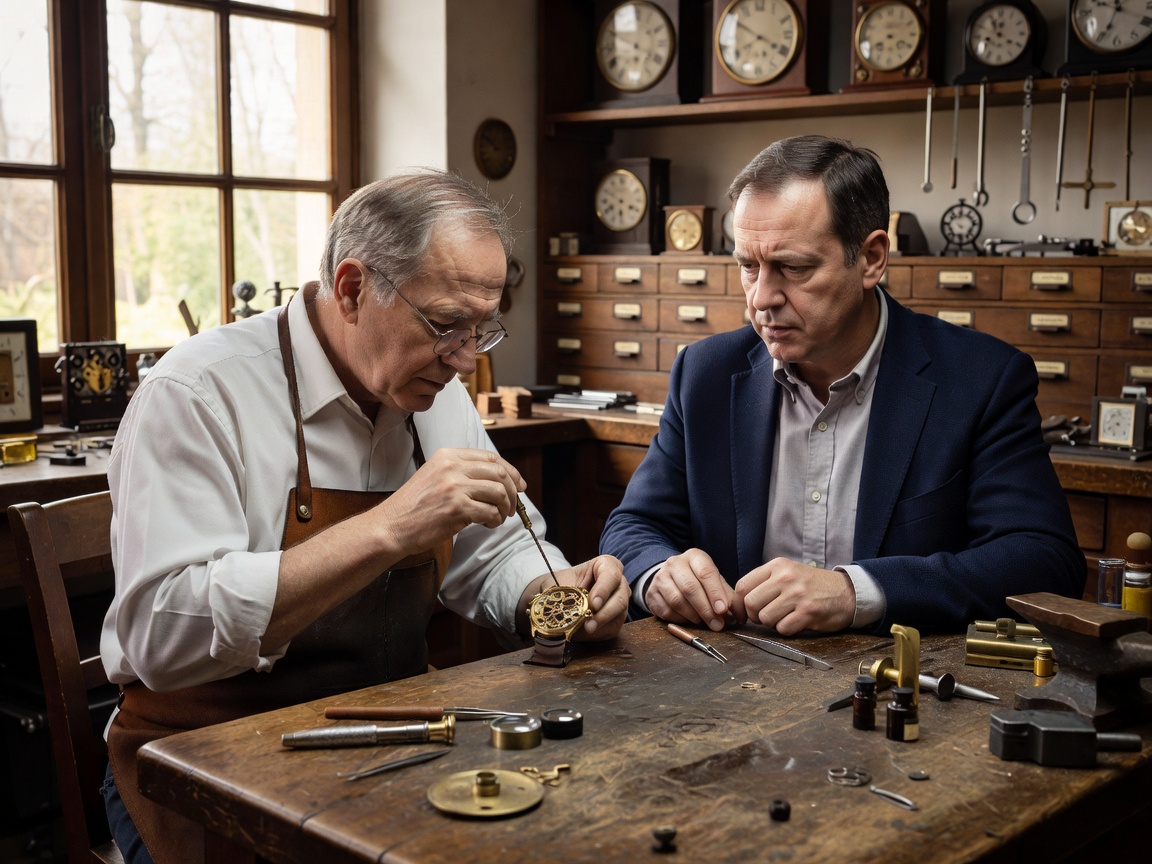
Record the exterior without improving it
Photograph the watch before cleaning. Use even light and include the dial, hands, crown, crystal, case sides, lugs, case back and bracelet or strap. A ruler beside the watch can provide scale, but photographs alone should not be used to infer precise dimensions. Record existing cracks, loose components, deep scratches and any visible signs of moisture.
Serial numbers, case references and movement markings may help identify a watch, but a matching number is not a complete authentication. Cases, movements and dials can be combined during a long working life. Brands such as Longines and Patek Philippe maintain historical services with their own eligibility and evidence requirements; an archive extract should be read according to the issuer's stated scope, not treated as a universal guarantee of every component.
Do not scrape away deposits to expose a marking at home. Do not open a case simply to satisfy curiosity. A fragile seal, damaged thread or loose hand can turn a modest investigation into new damage. Detailed internal examination belongs with a practitioner equipped for the construction and condition involved.
Measure before making promises
A watchmaker may begin with winding and setting behaviour, external magnetism checks and timing observations where running is safe. Any timing record needs context: state of wind, position, duration and movement characteristics. A strong-looking amplitude reading is not conclusive if the instrument uses the wrong lift angle. Equally, an irregular trace can have several causes rather than one obvious remedy.
Opening the case can reveal corrosion, contaminated lubricant, damaged screw heads, previous tool marks or incompatible replacement parts. Those findings should change the proposed scope when necessary. A preliminary estimate is not a reason to ignore newly discovered damage. Ask how additional work will be documented and approved before the assessment begins.
Turn findings into a consent boundary
A condition report should separate observations from interpretations and recommendations. “Rust visible on a screw” is an observation; “possible previous moisture entry” is an interpretation. Replacing a component is a proposed intervention. Keeping those categories distinct makes the reasoning easier to review.
Ask for an initial scope that names exclusions as clearly as inclusions. Case polishing, dial work, hand replacement and bracelet refinishing should not disappear into a general phrase such as “complete restoration.” Discuss whether removed parts can be returned and whether exchange requirements apply. Set a point at which work pauses for renewed consent.
You are looking for a process that can accommodate uncertainty without concealing it. A practitioner who explains the limits of an assessment is often offering something more useful than a confident promise made before examination.
Further reading and useful distinctions
The British Horological Institute, American Watchmakers-Clockmakers Institute and WOSTEP provide routes into horological education. Training is useful context when discussing experience, but no institution's name substitutes for a clear written scope for your particular watch.
Collection records at the British Museum and Science Museum demonstrate why identification, materials and historical interpretation are recorded separately. Manufacturer information from Longines and Patek Philippe can clarify the limits of their own historical services. These references are not endorsements of this journal.
Glossary: condition report
A dated account of an object's observed state. A useful report distinguishes visible facts, tests performed, uncertainties and recommended work.