Field guide 02 / Movement work
Restore function with a measured hand
The aim is not to persuade a tired movement to tick for a demonstration. It is to understand how its parts work together, address damaging conditions and document an appropriate result.
A service is a sequence, not a shortcut
A mechanical movement transfers stored energy through a train of wheels to an escapement and oscillator. Dirt, degraded lubricant and worn bearing surfaces can interfere with that transfer long before a watch stops. Adding fresh oil to an assembled, contaminated mechanism does not remove abrasive deposits or establish whether a pivot is damaged.
Proper work normally involves controlled disassembly, appropriate cleaning, inspection, reassembly, lubrication and testing. The exact method depends on the calibre, materials and condition. Some components require separate treatment or must be kept out of a particular cleaning process. This is one reason an owner's guide should explain principles rather than offer a universal bench recipe.
Ask whether the practitioner has experience with the relevant movement, including its complications. A chronograph, alarm or calendar adds interactions that may not be tested by observing the main time display. Familiarity with a manufacturer's current products does not automatically establish expertise with an early or unusual construction.
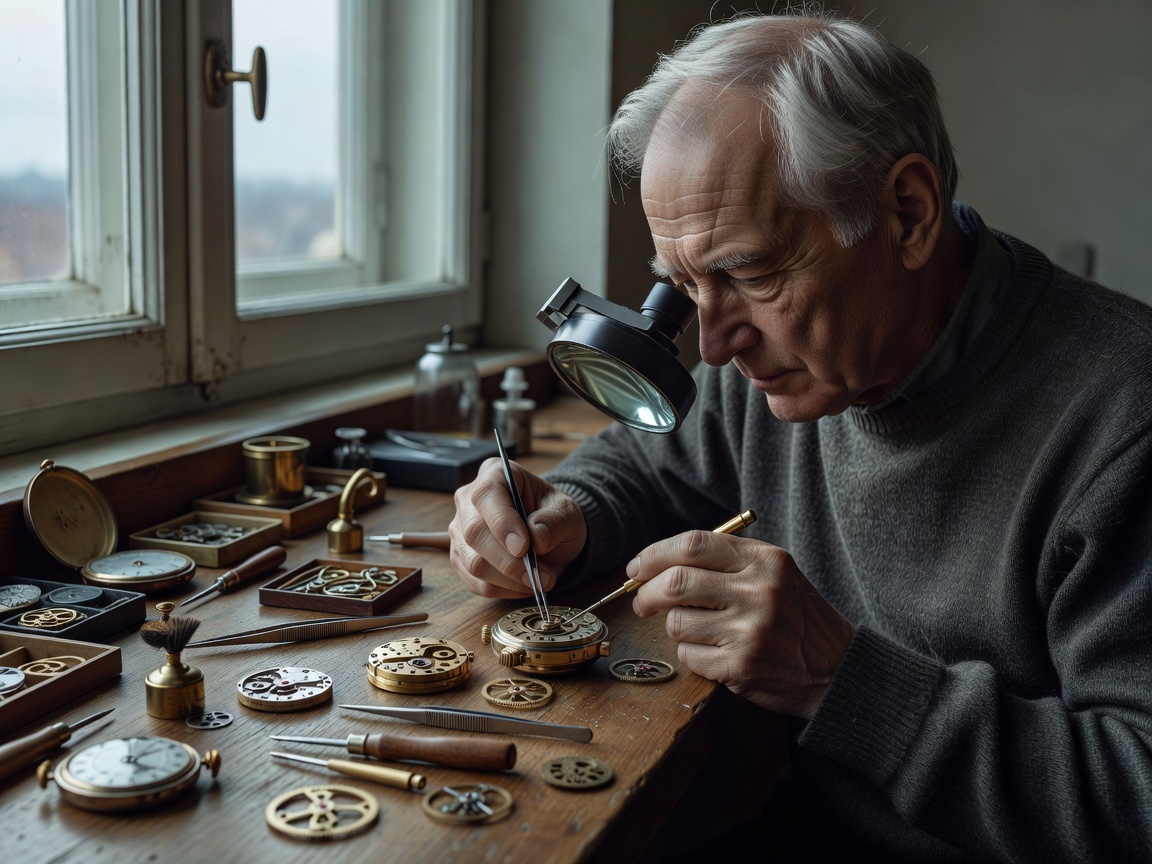
Inspect the causes, not only the symptoms
During inspection, a watchmaker considers pivots, jewels, teeth, springs, screw threads and the way components move in relation to one another. Excessive play, distorted parts and evidence of corrosion can explain behaviour that regulation alone cannot correct. A watch that loses time may need much more than a regulator adjustment; one that happens to keep reasonable time may still contain damaging wear.
Part replacement introduces a preservation decision. A suitable new component may improve reliability, while retaining a worn original might matter to historical interpretation. The answer depends on the part's role, its condition, the intended use and the availability of alternatives. Sometimes preserving a watch as a non-running object is more defensible than extensive reconstruction.
Discuss whether a replacement is manufacturer-supplied, compatible stock, an older unused component or a newly made part. “Original” can mean several different things in conversation. A clear invoice should identify the actual basis for that description and record significant modifications. Do not assume that a part bearing the correct brand name is automatically appropriate for every version of a calibre.
Lubrication is specific work
Different contact points have different loads, motions and material requirements. Lubricant choice, quantity and placement therefore matter. More is not automatically safer: excess lubricant can migrate to places where it impairs operation. Too little, an unsuitable product or application to an unclean surface can also cause trouble.
Technical literature from movement makers such as ETA and Sellita illustrates the specificity of movement documentation. Guidance from a lubricant manufacturer such as Moebius is another technical resource, not a substitute for identifying the exact construction. Historical movements may require judgement where current instructions are unavailable.
Read test results in context
Rate, amplitude and beat error are useful observations, not a universal pass certificate. Their interpretation depends on the movement, state of wind, position and test setup. Ask for the conditions alongside the figures, and for a comparison between early and later observations when that helps explain the outcome.
Testing may also include winding efficiency, power reserve, hand clearance, setting, calendar changes and chronograph functions where fitted. A watch can perform acceptably on a timing machine yet have a hand that catches during normal use. A useful completion record explains which functions were checked and which limitations remain.
Water resistance is separate. Replacing a gasket does not prove the assembled watch is water resistant. Case condition, crown construction and a suitable test all matter. Even a successful result describes a test at a particular time; it is not a permanent promise that an old watch is suitable for swimming.
Standards are not interchangeable
ISO 3159 concerns wrist-chronometers with spring-balance oscillators. ISO 22810 addresses water-resistant watches, while ISO 6425 concerns divers' watches. These are different scopes, not interchangeable labels for a completed vintage service. Certification programmes from COSC and testing associated with METAS likewise have defined criteria; an informal workshop reading should not be presented as either certification.
For a deeper account of mechanisms and craft, George Daniels's Watchmaking is an important technical reference. It is demanding reading rather than a safe starting point for dismantling an inherited watch. The practical lesson for owners is more modest: choose an informed scope, expect reasoned documentation and resist treating one attractive number as the whole story.
Glossary: amplitude and beat error
Amplitude describes the balance's angular swing. Beat error describes an asymmetry in the timing of alternating beats. Both require correct instrument settings and movement-specific interpretation.